
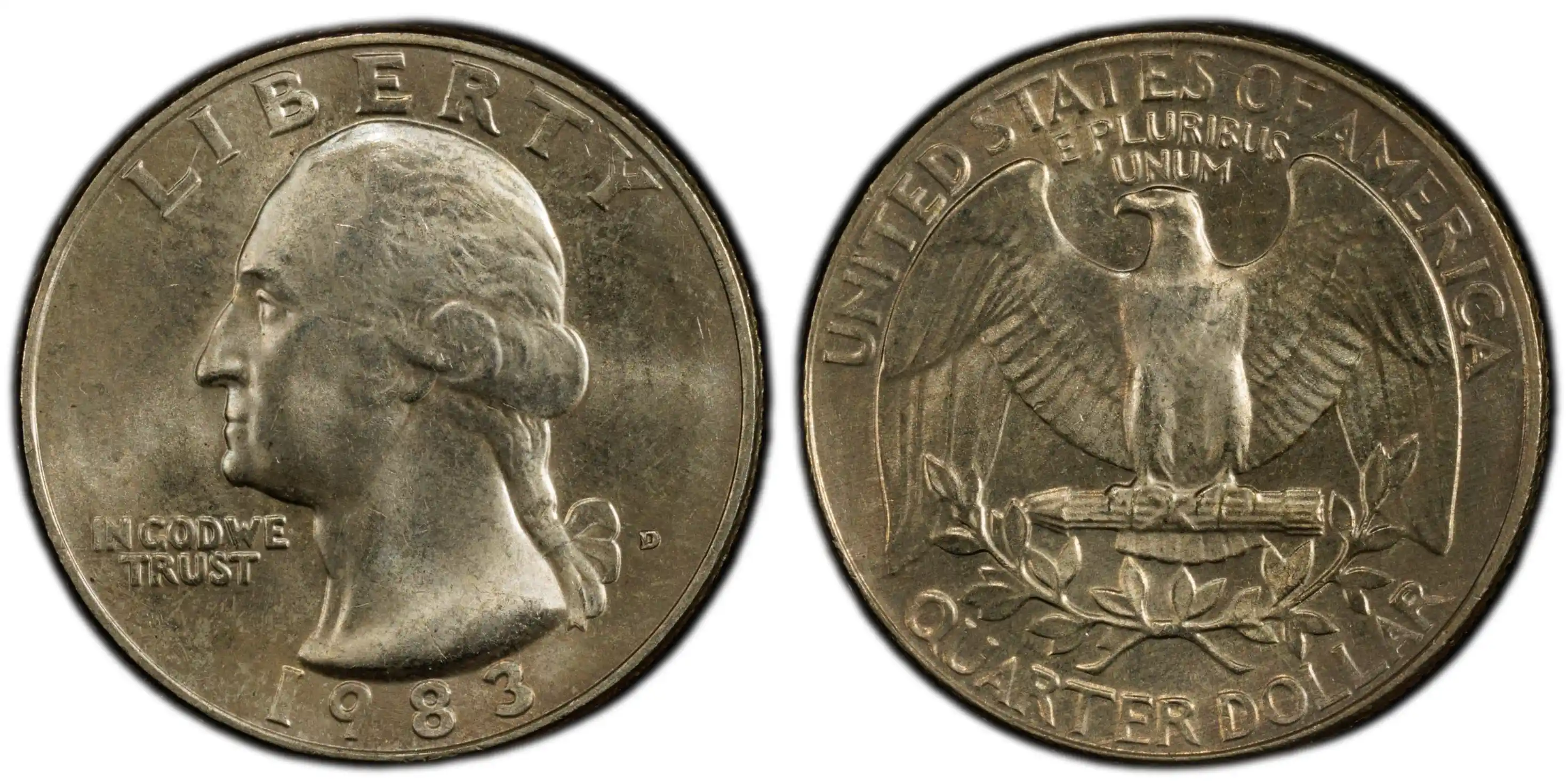
Circulated 1983 quarter price range starts from 1/4 of a dollar, but if you have a rare coin with defects, such as a Missing Outer Clad Layer or Spitting Eagle, the price skyrockets to $150 or more in a second.
Item Overview
Year | 1983 |
Diameter | 24.30 mm |
Weight | 5.67 g |
Composition | 75 % Copper / 25 % Nickel |
Edge | Reeded |
The production environment at the United States Mint during the early 1980s favored volume over quality. This philosophy led directly to a high frequency of physical errors.
Mechanical Strain and Die Longevity Issues
During 1983, both the Philadelphia and Denver mint facilities operated under intense pressure to meet the commercial demand for base-metal coins. To save money and meet strict production deadlines, mint workers pushed heavy mechanical equipment far past normal service limits.
Coin presses ran at maximum speeds for extended shifts.
Employees utilized individual steel coin dies long after the surfaces showed severe metal fatigue.
Working hubs degraded, which caused weak details on the legends and mottos of new coins.
This mechanical strain caused the steel dies to crack, chip, and distort. As a result, the machines stamped thousands of quarters with unique, unintended layout variations before workers finally replaced the damaged hardware.
The Rarity of Uncirculated Error Survivors
The lack of official government mint sets in 1983 creates a double layer of scarcity for error hunters. When an error occurs in a standard production year, a few examples usually end up inside the clean, plastic-sealed mint sets sold to the public. These coins remain perfect and free from scratches forever.
In 1983, every single error coin went directly into canvas transit bags. The heavy bags traveled via trucks to commercial banks, where automated machinery sorted the coins into paper rolls.
This brutal process left heavy marks on the coin surfaces. If you locate a genuine 1983 error that also retains its original mint luster and lacks surface scratches, you possess an incredibly rare item. Numismatists pay thousands of dollars for top-grade error survivors because transit damage ruined almost all concurrent pieces.
Major Die Varieties
Die varieties happen when a flaw exists in the steel die itself. Every single coin that the damaged die strikes will carry the exact same visual anomaly.
1983 P Spitting Eagle
The Spitting Eagle represents the most famous variety of the clad quarter era. Many casual collectors assume a simple die chip caused this error, but the true mechanism involves a severe die clash.
A die clash occurs when the automated feed system fails to place a raw metal planchet into the coin press. The obverse die and the reverse die then slam directly into each other under tons of hydraulic pressure. This violent collision transfers a faint, mirror image of the design elements onto the opposite die face.
For the P variety, a portion of George Washington's neck profile transferred onto the reverse die. This created a sharp, raised vertical line of metal that begins exactly at the eagle's beak and extends downward into the field. The final product makes the eagle look as if it spits a line of fluid.
Item Value $10–$150+
Doubled Die Obverse & Doubled Die Reverse
Doubled die errors occur earlier in the manufacturing process, during the creation of the working dies. If the master hub shifts position between separate alignment strikes, the letters and numbers double on the final steel die.
P Doubled Die Obverse – look closely at the front of the coin. The letters in the motto and the words show clear secondary images along the edges.
P Doubled Die Reverse – the back of the coin displays even stronger doubling. Examine the words. You will see clear separation lines on the vertical bars of the letters.
Item Value $25–$250+
Striking Phase Errors
Unlike die varieties, striking errors occur during the physical coin press action. These flaws are unique events that vary from coin to coin.
Off-Center Strikes and Partial Collars
When the mechanical gripper arms fail to deposit a metal blank squarely inside the die chamber, an off-center strike occurs. The dies press down on only a portion of the planchet, which forces the excess metal to expand outward into an asymmetrical shape.
Error | Visual Indicator |
Off-Center Strike | Missing design |
Partial Collar | Edge |
Off-Center Strike – part of the design is missing; a blank crescent of smooth metal remains on one side. The planchet sits partially outside the strike zone during the press cycle.
Partial Collar – the edge of the coin has a stepped appearance; reeding covers only half of the edge thickness. The steel collar restraint fails to rise fully around the coin blank during impact.
Item Value $30–$250+
Clipped Planchets & Broadstrikes
Planchet errors trace their origin back to the metal sheet blanking process. A heavy machine punches round disks out of a continuous strip of copper-nickel metal. If the metal strip feeds too slowly, the punch overlaps a section that the machine has already cut. This mistake leaves a curved bite mark on the edge of the disk.
A broadstrike happens when the circular steel collar wall breaks or retracts entirely during the strike. The collar normally holds the coin shape perfectly round and presses the reed lines into the edge. Without this restraint, the metal spreads flat and wide like a pancake. The coin loses its standard thickness but retains the complete design on both faces.
Item Value $20–$80+
Planchet and Composition Anomalies
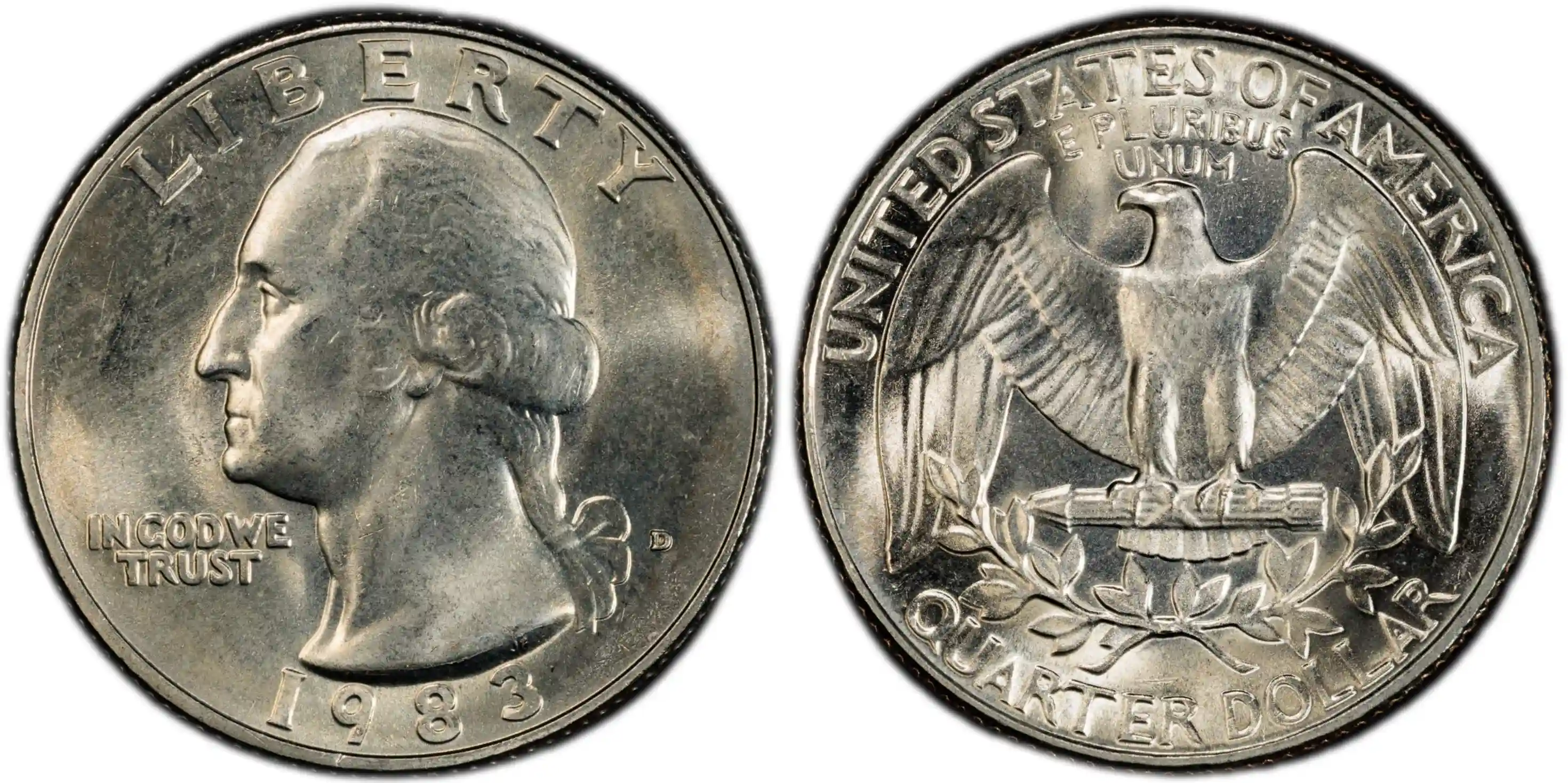
Some of the most valuable errors stem from chemical or structural flaws within the raw metal stock before the mint ever stamps the design.
Missing Clad Layers
Standard United States quarters utilize a layered composition. A pure copper center core sits between two outer layers of copper-nickel alloy.
A manufacturing error prevents the outer strip from bonding properly to the core before the blanking machine cuts the planchets. The outer layer can peel away entirely before the strike occurs.
Item Value $40–$150